
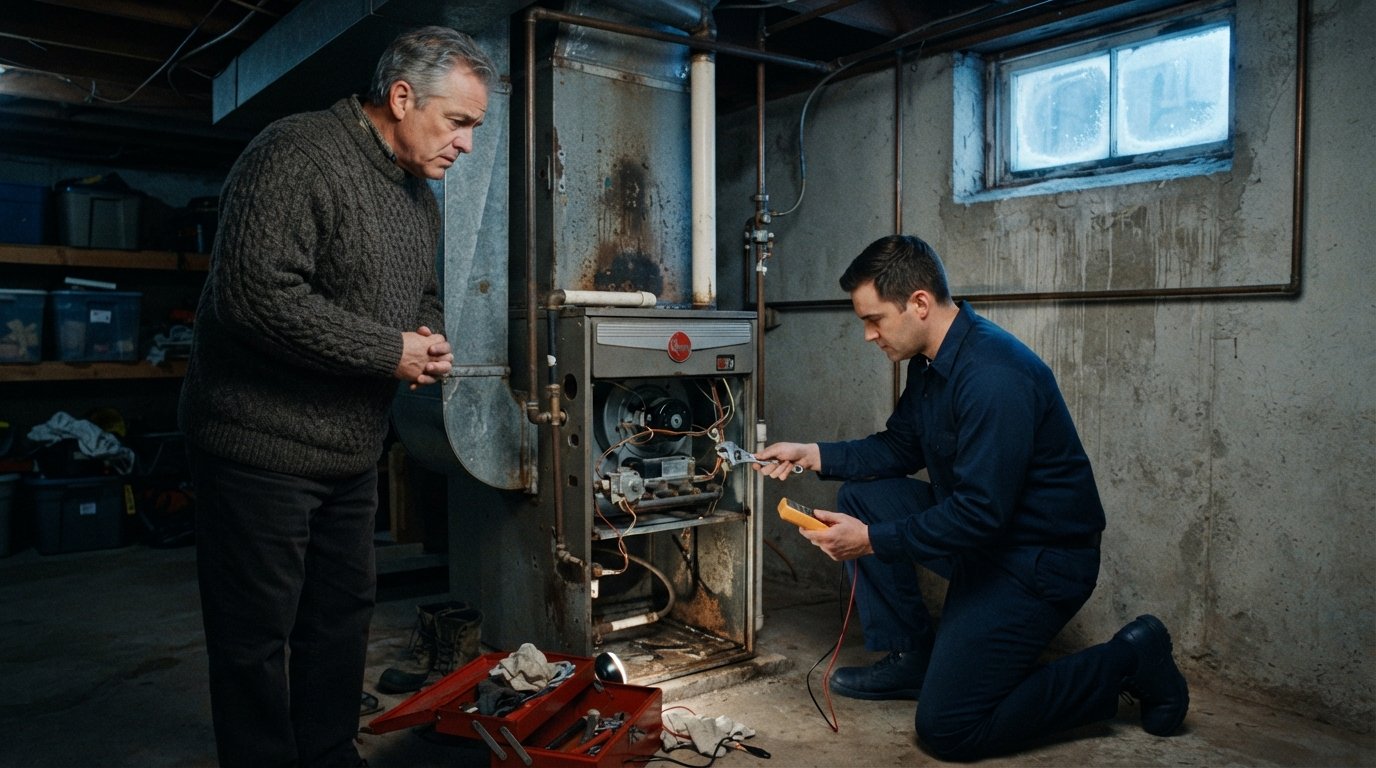
Emergency Home Repair Loan for Furnace Replacement
An emergency home repair loan for furnace replacement can restore heat fast. Call 8335013363 to compare offers and avoid surprise bills.

By Nathan Ellis
Your furnace stops working in the middle of a January cold snap. The house is losing heat fast, the pipes are at risk, and every contractor you call quotes a repair bill that runs into the thousands. This is exactly the kind of moment when an emergency home repair loan for furnace replacement stops being an abstract financial term and becomes a practical lifeline. The good news is that you do not have to navigate this alone, and you do not need perfect credit to find a workable option.
This guide walks through how furnace replacement loans work, when a repair makes more sense than a full swap, how to compare offers without wasting time, and what lenders actually look at when you apply. It is written for homeowners who need heat restored quickly and want a funding path that does not wreck their budget for the next five years.
Why Furnace Replacement Counts as a True Emergency
A broken furnace is not a cosmetic problem you can postpone until spring. In most of the country, a failed heating system creates immediate risks: frozen pipes that burst and cause water damage, health hazards for children, elderly family members, or anyone with respiratory conditions, and in some municipalities, a legal requirement that rental or occupied homes maintain a minimum indoor temperature. That combination of safety, property damage, and legal exposure is what pushes furnace replacement into the emergency category.
Repair costs also escalate quickly once a system fails completely. A blower motor replacement might run several hundred dollars, but a cracked heat exchanger, a failed control board, or a compressor issue on a heat pump can push the bill past the point where replacement is the smarter financial decision. When a technician tells you the unit is 15 to 20 years old and the repair will only buy you another season or two, financing a replacement often costs less over the next decade than repeated emergency repairs.
That is where an emergency home repair loan for furnace replacement fits in. Instead of draining an emergency savings account that may not exist, or putting the entire bill on a high-interest credit card, you spread the cost across a defined repayment period with terms you can review before signing. The key is understanding which loan type matches your situation.
Loan Options That Actually Cover a New Furnace
Not every loan product is built for a $4,000 to $12,000 home repair. Payday loans, for example, are short-term cash advances typically capped around $1,000 and due by your next payday, which makes them a poor fit for a full HVAC replacement. The better matches are personal loans, installment loans, and specialized home improvement financing. Each has trade-offs in speed, amount, and cost.
Here is a quick comparison of the main categories homeowners use when a furnace dies:
- Personal loans: Unsecured, amounts often start near $1,000 and can reach $50,000 depending on the lender and your qualifications. Funding can arrive as soon as the next business day.
- Installment loans: Repaid in fixed monthly payments over an agreed term, frequently used for amounts under $5,000. Predictable but sometimes pricier than a personal loan for the same amount.
- Emergency loans: Designed specifically for urgent expenses like a failed furnace, with fast application and short approval windows.
- Contractor or manufacturer financing: Offered directly by some HVAC companies, often with promotional rates, but approval standards vary widely.
For most homeowners facing a sudden furnace failure, a personal loan or an emergency loan offers the best balance of speed and amount. If you want to see how multiple lenders stack up before committing, an emergency loan quote comparison can save hours of individual applications and give you a clearer picture of realistic rates for your credit profile.
One important note: FreeQuotes.Loans is a connection service, not a direct lender. It matches your single request with third-party lending partners who set their own terms, rates, and repayment schedules. That means the quotes you receive are real offers from real lenders, but the final agreement is between you and the lender that funds your loan.
How to Get Funded Fast Without Wasting Applications
Speed matters when the temperature is dropping, but applying blindly to a dozen lenders can hurt your credit score and slow you down. A smarter approach is to gather your documents first, then submit one request that can be matched with multiple lenders. This is the model FreeQuotes.Loans uses, and it is also how most reputable comparison platforms operate.
Before you apply, have these items ready:
- Government-issued photo ID and proof you are at least 18 years old.
- Proof of consistent income, which can include employment, self-employment, disability, pension, or government assistance.
- An active bank account in your name for direct deposit of funds.
- A written estimate from your HVAC contractor showing the replacement cost.
With those in hand, the application itself usually takes under five minutes. You submit one form, lenders review it, and you receive offers to compare. From there, you choose the offer with the best combination of APR, term length, and monthly payment for your budget. Funds can often be deposited as soon as the next business day, which is fast enough to schedule the install before pipes freeze.
If your credit history is less than perfect, do not assume you are disqualified. Many lenders in the emergency loan space work with borrowers who have previous bankruptcies, late payments, or even a prior vehicle repossession, as long as there is stable income coming in. The trade-off is usually a higher rate, so compare carefully and avoid the first offer that lands in your inbox.
For borrowers who want a broader menu of short-term options, including payday and installment products from third-party lenders, services like AdvanceCash operate on a similar connection model and can be worth reviewing alongside your primary comparison. The goal is not to apply everywhere, but to understand the range of what is available before you sign.
Repair or Replace: Making the Right Call
Financing a replacement only makes sense if replacement is genuinely the better option. Sometimes a $400 repair extends the life of your furnace by several years, and taking on a loan for a full swap would be an unnecessary expense. Other times, patching an aging unit is throwing money at a system that will fail again within months.
Consider replacement when the furnace is 15 years or older, when the repair cost exceeds half the price of a new unit, when the heat exchanger is cracked (a carbon monoxide risk), or when your energy bills have climbed steadily as the system struggles to keep up. Consider repair when the unit is under 10 years old, the fix is a single component like a thermostat or igniter, and the technician expects the system to run reliably for several more seasons.
If you land on replacement, get at least two written estimates. HVAC pricing varies significantly by region, brand, and whether you choose a standard efficiency unit or a high-efficiency model. A loan sized to the actual installed cost, not a rough guess, keeps your monthly payment realistic and prevents you from borrowing more than you need.
What Lenders Look At When You Apply
Understanding underwriting helps you present your situation in the best light. Lenders evaluating an emergency home repair loan for furnace replacement typically weigh four factors: income stability, credit history, existing debt load, and the size of the requested loan relative to your income. A steady paycheck, even a modest one, often matters more than a high credit score for smaller loan amounts.
Credit history still plays a role. A score in the prime range unlocks lower APRs and longer terms, while a subprime score usually means higher rates and shorter repayment windows. Some lenders specialize in bad credit personal loans and will approve based on income alone, but the cost of that approval is baked into the rate. Read the truth-in-lending disclosure carefully, because the APR includes both interest and fees and is the only number that lets you compare offers apples to apples.
Debt-to-income ratio is the other big lever. If your existing monthly obligations already consume a large share of your income, lenders may reduce the amount they are willing to offer or decline the application. Paying down a credit card balance before applying, even partially, can improve your odds and your rate.
Protecting Yourself From Predatory Terms
Urgency is a predator's best friend. When you need heat restored today, it is tempting to accept the first offer without reading the fine print. Resist that impulse. A legitimate emergency loan will have clear terms, a stated APR, a defined repayment schedule, and no pressure to sign on the spot.
Watch for these red flags:
- Fees that are not disclosed until after you commit.
- Pressure to provide collateral you cannot afford to lose.
- Promises of guaranteed approval with no income verification.
- Requests for upfront payment before funds are disbursed.
Reputable connection services never charge you a fee to submit a request, and they never guarantee approval. If a platform asks for money before you have a loan in hand, walk away. FreeQuotes.Loans, for example, charges no fee for its matching service and clearly states that all loan terms are determined by the third-party lenders in its network.
Also remember that missing a payment or paying late can damage your credit score and trigger additional fees. Before you sign, confirm that the monthly payment fits comfortably within your budget, not just for the first month but for the full term. A furnace replacement loan that stretches your finances too thin can turn a heating emergency into a debt emergency.
Building a Small Buffer for Next Time
Once the new furnace is installed and the house is warm again, the smartest move is to start preparing for the next surprise. Homeowners who set aside even $50 to $100 per month in a dedicated home repair fund are far less likely to need emergency financing when the water heater, roof, or air conditioner fails. The goal is not to eliminate loans from your toolkit, but to make them a choice rather than a necessity.
If you do need to borrow again, the process will be faster because you will already know your credit profile, your income documentation will be current, and you will have a sense of which lenders offer the best terms for your situation. That familiarity is worth real money over the life of a loan.
A failed furnace is stressful, but it is a solvable problem. By understanding your loan options, applying through a comparison service that matches you with multiple lenders, and reading every disclosure before you sign, you can restore heat quickly without derailing your finances. Start with a single request, compare the offers side by side, and choose the one that keeps your monthly payment manageable through the entire repayment term.